
Design Team: Wang Yutong (Project Manager) | Bidding Stage: Han Jizhe, Wang Lei, Li Xiaoye | Zhao Congcong, Zuo Sichuang (Intern) | SD to CD Phases: Yao Yongmei, Zhang Fujun, Wang Jingfei, Zhao Ping, Chen Yu, Chai Bingjiang, etc.
The Vanke School of Public Health, Tsinghua University’s building was adapted from the Jin-Chun-Garden Hotel. After the school was established in 2020, the university decided to renovate this existing late-1980s building on the Jin-Chun-Garden site to rapidly meet teaching, research, and academic-exchange needs. Adjacent to the landscape described in Zhu Ziqing’s “Moonlit Lotus Pond,” the building carries imperial-garden heritage and collective campus memory, giving it a distinctive cultural depth. The renovation faced multiple constraints: the original building is a masonry shear-wall structure with a floor-to-ceiling height of only 3.2 m; it lies within the “Three Mountains and Five Gardens” scenic-control zone with strict height limits, so demolition and rebuild were infeasible; and the design was required to retain the façade that represents late-1980s architectural character. Under the premise of preserving the exterior walls, the project achieved a sustainable renewal of a fully functional, humane school facility through structural regeneration, spatial reorganization, and ecological restoration.
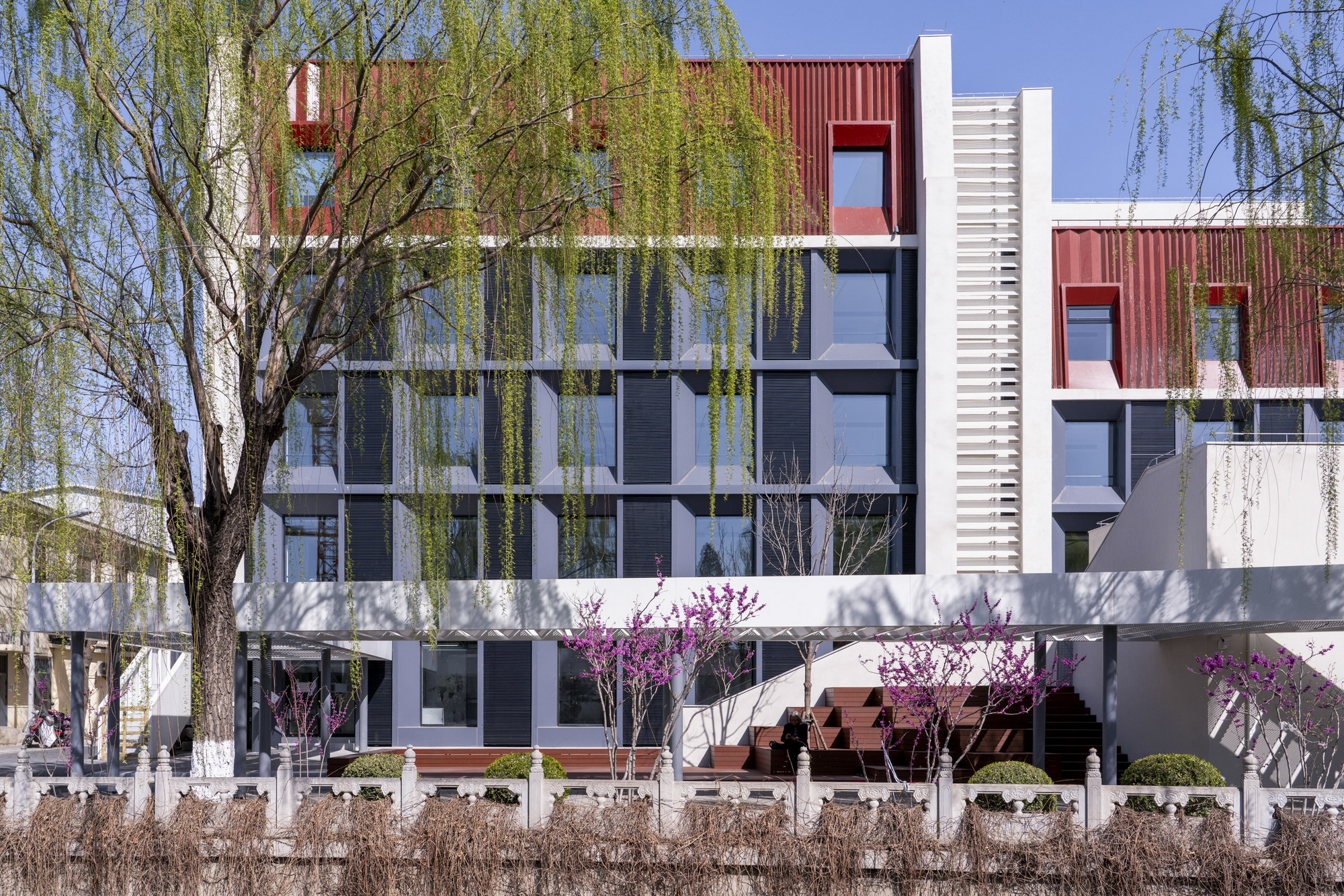
The design fully preserves the original principal façade and volumetric profile, achieving the building’s transformation with minimal intervention. This strategy avoids the resource consumption and carbon emissions of large-scale demolition and reconstruction, while safeguarding campus collective memory. The façade update follows the principle of “respecting the original, refining the details”: original small guest-room balconies were integrated into large transparent glass bay windows with ventilation panels concealed at the sides, improving visual continuity; the sloped roof was replaced with lightweight perforated aluminum panels that present a refined texture by day and become a gentle luminous element at night. This subtle exterior treatment delivers both performance and aesthetic upgrades, embodying a sustainable design philosophy for contemporary insertion within a historic context.
The structural intervention used a “surgical” regeneration technique. By retaining the peripheral shear walls, the exterior façade could stand independently, allowing the building core to be completely excavated and a new steel structural system to be inserted, creating a hybrid of old and new. To address stiffness mismatch between the new steel structure and the reinforced masonry, a multi-layered lateral-resistance system was adopted—combining steel-plate shear walls, steel bracing, and reinforced masonry walls—to ensure safety under extreme loading. Using an innovative reverse-construction method and precise monitoring, the floor slabs were successfully removed, fully liberating the interior while keeping the exterior walls in situ. This technical system provides a replicable pathway for sustainable retrofits of many similar masonry buildings.
To improve spatial efficiency, the design makes full use of the limited clear height by introducing three double-height atria, which significantly enhance daylighting and ventilation, reduce the corridor’s oppressive feel, and create visual and interaction cores. Open research zones, seminar spaces, and humanistic nooks are organized around the atria to foster cross-disciplinary academic exchange. The rooftop terraces were activated as viewpoints and recreational areas, expanding usable space without adding footprint. Careful equipment integration and utility planning enabled orderly accommodation of HVAC, fire protection, and other systems within the 3.2 m floor height.
The project also treats the building retrofit as a catalyst for ecological repair and the activation of campus public life. Illicit and chaotic service additions along the Wan-Quan River were removed and replaced by a lightweight landscaped corridor that converts the previously negative service edge into an attractive waterfront public realm for faculty and students. The entrance is articulated by a refined landscape wall that defines the forecourt while preserving existing trees, creating a ceremonial campus interface. Interior circulation spaces were transformed into rich social nodes. Beyond the single building, the renovation performs a stock-based renewal that concentrates resources, continues cultural context, restores ecology, and contributes public space—delivering multiple dimensions of sustainable value.
Credits:
Project Location: Beijing
Design Period: 2021-2023
Construction Period: 2023-2025
Site Area: 6,152㎡
Floor Area: 5,950㎡
Client: Tsinghua University
Collaborators:
Construction Documents: Huacheng Boyuan Engineering Technology Group Co., Ltd. |Cui Li, Huang Yiyang, Li Tao, etc.
Structural Consultant: DS Studio, Huacheng Boyuan Engineering Technology Group Co., Ltd. |Wang Lijun, Tan Jinpeng, Yu Wenhua
Lighting Consultant: X Studio, School of Architecture, Tsinghua University | Zhang Xin, Wang Dan, Wu Zhaofeng, Zhangzhenhong, Jiang Bin, Zhao Xiaobo
FF&E Consultant: Institute of Spatial Intelligence and Material Innovation, Academy of Arts & Design, Tsinghua University | Yang Dongjiang, Shi Shuo, Xu Buting, Liu Qingzhou
Energy Efficiency Consultant: Architectural Design & Research Institute of Tsinghua University Co., Ltd
Curtain Wall Consultant: Muhua Construction Co., Ltd.
General Contractor: Beijing Third Construction Engineering Co., Ltd.
Photographer: UK Studio
